Summary:
You know what a bad supplier costs you. It’s not just the price per pallet — it’s the Monday morning phone call when the material didn’t show, the crew standing around, and the general contractor asking questions you don’t have answers to yet. Finding a masonry supply yard that actually functions as a supply partner, not just a transaction window, is harder than it should be.
We’ve been operating out of 747 Meacham Avenue in Elmont, NY since 1956, and we’ve seen every version of this problem. What follows is an honest look at what commercial contractors in Nassau County should be thinking about when they evaluate a masonry supplier — and what we’ve learned matters most after nearly 70 years in this market.
Building Construction Supplier Criteria That Actually Matter on Commercial Jobs
Most contractors already know the basics — price, location, hours. What gets overlooked is everything that matters when a project is mid-stream and something goes wrong. Can your supplier fill a partial reorder on short notice? Does the person behind the counter know the difference between a product that’ll hold up through a Nassau County winter and one that’ll start failing after the first hard freeze? Does the yard stock what they say they stock, or are you waiting on a special order that’s three weeks out?
These aren’t hypothetical questions. They’re the ones that separate a supplier relationship worth keeping from one that costs you more than you saved on the original quote. Evaluating a building construction supplier for commercial work means looking past the surface and asking about inventory depth, counter expertise, and what happens when you actually need us to come through.
How to Evaluate Inventory Depth Before You Commit to a Supplier
Inventory depth is the difference between a supplier who can fill your order and one who can fill your order completely, accurately, and without substitutions. On a commercial job, that distinction is everything. If you’re three weeks into a paving project and your supplier runs out of the exact Cambridge paver style and color you spec’d, you’re either waiting, substituting, or explaining to your client why the second phase doesn’t match the first. None of those options are good.
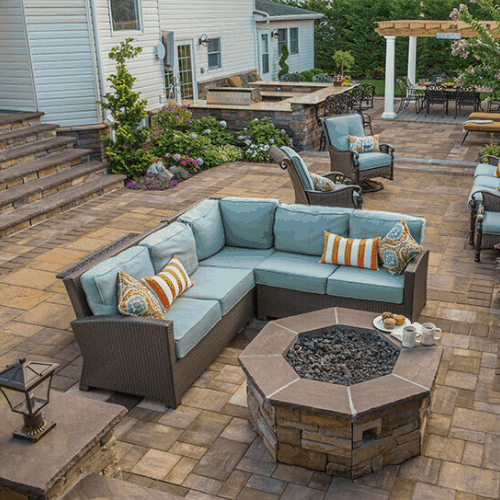
When we talk about inventory depth, we mean having the full product line — not just the popular sizes and colors — along with the supporting materials that make a complete installation possible. Cambridge pavers, wall stone systems, polymer sand, geotextiles, base materials, mortar, tools. The job doesn’t stop at the paver itself, and we don’t either.
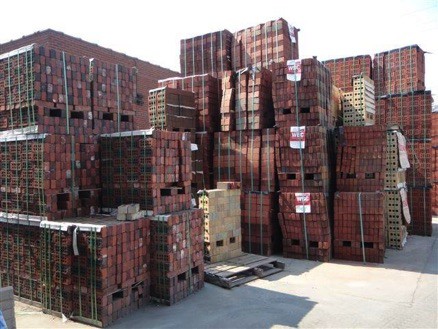
Our 20,000 square foot facility in Elmont is stocked to handle commercial-scale orders across the full Cambridge Pavingstones line, plus brick from manufacturers like Cushwa and Belden, Pennsylvania Bluestone, Indiana Limestone, Eldorado Stone, and the sand, gravel, and bagged products that round out a complete masonry job. If something isn’t on the floor, we’ll order it. But for most of what Nassau County contractors are running day to day, it’s already here.
The other piece of inventory evaluation that doesn’t get talked about enough is consistency across a multi-phase project. Commercial jobs don’t always get done in one pull. You need a supplier who can guarantee that what you order in April is still available — same dye lot, same spec — when you come back in July. That’s a conversation worth having before the job starts, not after.

Why Counter Expertise Matters More Than Price on Commercial Projects
Price matters. Nobody’s pretending otherwise. But the contractors who’ve been doing commercial work in Nassau County for a long time will tell you that what they’re really paying for at a supply yard is the expertise behind the counter — because that expertise prevents expensive mistakes.
Getting the quantity wrong on a large brick order means either a short delivery that stalls the job or leftover material you’re figuring out what to do with. Specifying the wrong base depth for Nassau County’s soil conditions means a paver installation that looks fine in the fall and starts shifting by spring. Choosing a product that looks great in a photo but doesn’t perform in a freeze-thaw climate means a callback from a client who expected better.
Pete and Steve at our counter have a combined 50-plus years in masonry supply. They know the products, they know the local conditions, and they know how to calculate a material order accurately so you’re not guessing. When a customer forgot to place a large brick order on a Monday morning and needed it on the job that day, we figured it out. That kind of response isn’t something you get from a yard where nobody knows your name or your project.
The point isn’t that expertise replaces competitive pricing — it’s that expertise prevents the kind of errors that cost far more than the difference between two quotes. For commercial contractors managing tight margins and tighter timelines, that matters.
Paver Installation Considerations Specific to Nassau County, NY
Nassau County isn’t a generic suburban market. It has specific soil conditions, a climate that punishes poor installation, and a regulatory environment spread across 53 municipalities, each with its own building department and permit process. The material decisions you make at the supply yard directly affect how a project performs five years from now — and whether your client is calling you with a compliment or a complaint.
Understanding the local factors that affect masonry performance is part of what we bring to the counter conversation. It’s also part of why sourcing from a supplier with deep roots in this specific market is worth more than it might look like on a spreadsheet.
How Nassau County Soil and Climate Affect Paver Base Preparation
Long Island’s soil is predominantly sandy and glacially deposited, which sounds like good news for drainage — and in many areas, it is. But portions of Nassau County, particularly in older residential neighborhoods and interior areas, have clay-heavy or silty layers that behave differently. Clay soil expands when wet and contracts as it dries. That ground movement, repeated over seasons, is exactly what causes paver installations to heave, shift, and fail prematurely.
The fix isn’t complicated, but it has to be done right from the start. Proper sub-base depth, appropriate compaction standards, and the right geotextile layer make the difference between an installation that holds and one that needs to be pulled and reset in three years. These aren’t optional details — they’re the foundation of every Cambridge Pavingstones installation we spec from our yard.
Then there’s the freeze-thaw factor. Nassau County experiences roughly 25 to 35 freeze-thaw cycles every year. Water infiltrates joints and sub-base material, freezes, expands, and either cracks the surface or heaves the base. Products without proper surface treatment and ICPI-compliant installation are far more vulnerable to this failure mode. Cambridge pavers with ArmorTec® are specifically engineered to handle this kind of environmental stress, and the transferable lifetime warranty backs that up in writing — which is something you can put directly in front of your client when you’re closing a bid.
For contractors working near Nassau County’s south shore — Long Beach, Atlantic Beach, the Five Towns waterfront communities — there’s an additional layer of consideration. Salt air and moisture exposure accelerate masonry deterioration in ways that inland projects don’t face. Material selection in coastal areas needs to account for that, and it’s the kind of detail that a supplier with real local knowledge will bring up without being asked.

What Nassau County Contractors Ask Us Most Before Starting a Commercial Job
A few questions come up consistently when commercial contractors are scoping a job in Nassau County, and they’re worth addressing directly.
The first is whether Cambridge pavers are appropriate for commercial-traffic applications. The short answer is yes. Cambridge Pavingstones with ArmorTec® are used in commercial driveways, parking areas, and high-traffic hardscape applications — not just residential patios. The ICPI-certified manufacturing process and the installation guidelines that back the lifetime warranty are built around structural performance, not just aesthetics. If a client or a GC pushes back on pavers versus poured concrete, the warranty and the engineering spec are your answer.
The second question is about the Cambridge Premier Dealer designation and what it actually means for the contractor. It’s not a marketing label — it’s a manufacturer-granted credential that requires demonstrated product volume, staff training, and service standards. As a Premier Dealer, we carry every Cambridge product type, style, and color. We have access to the full line, not a curated subset. And when a product question comes up that requires a direct line to Cambridge, we have it.
The third question, which comes up most often from contractors who haven’t worked with us before, is whether we can handle commercial-scale orders or whether we’re primarily a homeowner retail operation. We’re open to the public — homeowners are welcome, and we treat them well — but our hours, our inventory, and our counter staff are built around the contractor’s workday. We open at 7AM Monday through Friday and 7AM on Saturday. That’s not an accident. It’s because the contractors we’ve served since 1956 need to pick up materials before the first pour of the day, not after.
We’re located in Elmont, right at the Nassau/Queens border, which means whether your job is in Valley Stream, Hempstead, Jamaica, or the Five Towns, you’re not driving past three other yards to get here. The location has been the same for nearly 70 years, and so has the commitment to having what you need when you show up.
Finding the Right Masonry Supply Yard in Nassau County, NY
The best time to evaluate your masonry supplier is before a project starts — not mid-job when you’re already depending on us. Look for inventory depth you can verify, counter staff who can actually answer technical questions, and a track record that goes beyond a few good reviews.
For commercial contractors in Nassau County, the local conditions — soil variability, freeze-thaw cycling, coastal exposure, and a fragmented permitting landscape across dozens of municipalities — make material selection and supplier reliability more consequential than they are in more forgiving markets. The right supplier relationship saves you time, prevents costly errors, and gives you a warranty you can stand behind with your clients.
If you’re sourcing materials for an upcoming commercial project and want to talk through what you need, we’re at 747 Meacham Avenue in Elmont, NY. We’ve been here since 1956. We’ll be here when you need us.