
Summary:
You got a contractor quote and your stomach dropped a little. That’s a familiar feeling for a lot of Nassau County homeowners right now. Material costs have climbed steadily over the past few years, and the gap between what a project should cost and what suppliers are charging has never felt wider.
The good news is that used, reclaimed, and budget-conscious building materials are a real option — not a compromise. But there’s a right way to approach them. This guide walks you through what to look for, what to avoid, and how to make smart sourcing decisions for your specific project.
How to Evaluate Cheap Building Materials Without Getting Burned
The word “cheap” gets a bad reputation in construction, but it really just means cost-effective when you know what you’re doing. The problem isn’t buying used or budget materials — it’s buying them without knowing how to assess what you’re actually getting.
Start with the source. Materials from a deconstructed building — where crews carefully disassemble rather than demolish — are in significantly better condition than materials pulled from a demolition site. The difference shows up in cracking, contamination, and dimensional consistency. Ask where the material came from before you load it into your truck.
What to Check Before Buying Used Masonry Materials
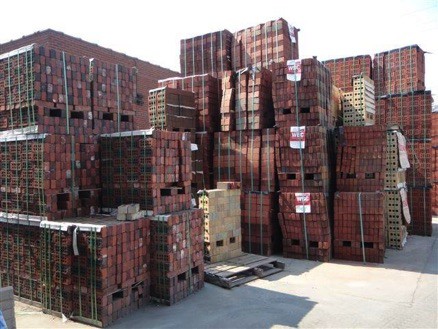
For brick, block, and stone, the evaluation process is mostly visual — but you have to know what you’re looking at. Spalling is the first thing to check. That’s when the face of a brick starts flaking or peeling, usually from freeze-thaw damage. In Nassau County, where winters cycle between freezing and thawing multiple times in a single week, spalled brick is a sign the material has already been compromised. It won’t hold up through another few seasons.
Look at the mortar contamination next. Reclaimed brick with heavy mortar still attached can be cleaned, but it takes time and labor. If you’re doing the work yourself, factor that in. If you’re paying a mason by the hour, those extra cleanup hours can quietly erase the savings you thought you were getting.
Dimensional consistency matters more than most people realize. If you’re patching an existing wall or extending a paver field, inconsistent sizing creates gaps, lippage, and an uneven finish that’s hard to correct after the fact. Lay a few pieces side by side before you commit to a full order.
For natural stone like Pennsylvania Bluestone or limestone, check for existing cracks running through the face — not surface scratches, but structural fractures. A cracked flagstone will split under foot traffic or freeze pressure. Hold it up to the light at an angle if you have to. It’s worth the extra minute.
One thing that often gets overlooked: older materials from Nassau County’s post-WWII housing stock — most of which was built between the mid-1940s and mid-1960s — may have been coated with lead-based paint. If you’re sourcing brick or block from a structure built before 1978, ask directly about lead paint testing. It’s not a reason to walk away automatically, but it is something you need to know before you handle, cut, or install those materials.

Do Used Building Materials Meet New York Building Code?
This is one of the most common questions we hear, and the honest answer is: yes, they can — but it depends on the material, the application, and how the work is being done.
New York State Building Code, which Nassau County follows, doesn’t prohibit reclaimed or used materials. What it requires is that all materials meet the performance standards for their intended use — load-bearing capacity, fire resistance, energy code compliance, and so on. The material’s age or origin doesn’t automatically disqualify it. What matters is whether it can do the job safely.
Where this gets complicated is with permitted work. If you’re pulling a building permit in Nassau County — which is required for most structural masonry work, retaining walls above a certain height, and many hardscape installations — your permit application will ask for material specifications. That means you need to be able to document what you’re using and confirm it meets code requirements. A salvage yard transaction with no paperwork doesn’t give you that. A reputable supplier who knows the product line and can speak to its specs does.
This is one of the practical reasons why buying from an established local supplier matters more than people initially think. When you’re standing at a permit office trying to explain what your materials are rated for, “I got them from a guy” is not a useful answer. Having a receipt, a product spec sheet, and a supplier who’s been in business since 1956 gives you something to work with.
One more thing worth knowing: Nassau County has dozens of villages and incorporated communities, and some of them have additional aesthetic requirements for exterior improvements — particularly in areas like Garden City, Floral Park, and Malverne. If your project is visible from the street, it’s worth a quick call to your village building department before you source materials, just to confirm there are no local restrictions on material type or appearance.
Eco-Friendly Building Materials That Also Save You Money
There’s a common assumption that eco-friendly building materials cost more. In some categories — high-end recycled glass surfaces, specialty bamboo flooring, cutting-edge insulation systems — that’s true. But for most masonry and hardscape projects, the most sustainable option and the most affordable option are often the same thing: reclaimed and recycled materials.
The environmental math is straightforward. Every ton of reclaimed stone or brick that gets reused is a ton that doesn’t end up in a landfill, and a ton of new material that doesn’t need to be quarried, manufactured, and shipped. Reusing what’s already been made is genuinely impactful, and it doesn’t require a premium price tag.
Reclaimed vs. Recycled vs. Salvaged — What's the Actual Difference?
These three terms get used interchangeably, but they describe different things, and the distinction affects what you’re getting.
Reclaimed materials are original building components that have been carefully removed from a structure and made available for reuse in their original form. Reclaimed brick is still brick — the same dimensions, the same material, just from a previous life in another building. Reclaimed Pennsylvania Bluestone pulled from an old patio is the same stone it always was. In many cases, reclaimed materials from older construction are actually denser and more durable than their modern equivalents, because they were made when raw material standards were higher and old-growth sources were still available.
Recycled materials have been processed or reformulated from construction waste. Recycled aggregate — crushed concrete used as a base material — is a common example. Recycled content insulation, recycled glass tile, and recycled steel all fall into this category. These are manufactured products that incorporate post-consumer or post-industrial waste, and they typically come with standard specs and certifications.
Salvaged materials are a broader category that includes anything recovered from a structure, sometimes with less documentation or quality control than reclaimed sources. Architectural salvage shops on Long Island often carry salvaged doors, windows, and decorative elements — great for interior projects where the aesthetic value outweighs structural concerns. For exterior masonry and hardscape, you want to be more careful about the source and condition.
For Nassau County homeowners, the most practical category for outdoor projects is usually reclaimed stone and brick for repair work, and recycled aggregate for base preparation under new hardscape. Both are widely available, genuinely cost-effective, and environmentally sound. The savings compared to all-new materials can reach 30–50% on the right project, which on a full driveway or patio installation is a meaningful number.

When New Materials Are Actually the Smarter Budget Choice
Here’s something that doesn’t get said enough in the reclaimed materials conversation: sometimes buying new is the more cost-effective decision over the long run, and knowing when that’s true is just as important as knowing how to find quality used materials.
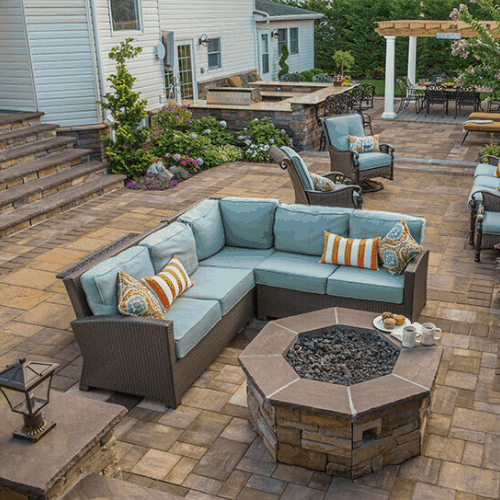
The clearest example is pavers. If you’re installing a new driveway, patio, or walkway from scratch — not patching an existing one — reclaimed pavers can introduce real complications. Color variation across a large surface is hard to control when you’re pulling from multiple salvage sources. Dimensional inconsistency creates installation headaches that translate directly into labor hours. And used pavers carry no warranty, which means if you have settling, cracking, or surface deterioration in year three, the cost of repair comes entirely out of your pocket.
A quality paver from a reputable manufacturer, installed correctly on a proper base, can last decades with minimal maintenance. Cambridge Pavingstones come with a transferable lifetime warranty — meaning it stays with the home even if you sell. In Nassau County’s real estate market, where curb appeal directly affects sale price and buyers notice the difference between a well-installed paver driveway and a patched-together one, that warranty has real value beyond just the material itself.
The way to think about it: used and reclaimed materials are often the right call for repair work, accent applications, and projects where matching existing materials is the goal. For new installations where you’re starting with a blank slate, the combination of supply-yard pricing and a manufacturer warranty on new materials can actually come out ahead — both in upfront cost and in what you avoid paying down the road. The honest answer to “should I buy used or new?” is almost always “it depends on the project,” and anyone who tells you otherwise is oversimplifying it.
This is also where having knowledgeable counter staff makes a difference. Not someone trying to upsell you, but someone who’s seen enough projects to tell you what actually holds up in Nassau County’s climate — the freeze-thaw cycles, the salt air on the South Shore, the heavy foot traffic on a family driveway — and what tends to fail within a few seasons.
Where Nassau County Homeowners Can Get Honest Answers on Building Materials
The used building materials market is real, it’s growing, and it can save you significant money on the right project. But it rewards buyers who go in informed. Knowing how to read a material’s condition, understanding what Nassau County’s permitting process requires, and recognizing when new materials are actually the smarter investment — that’s what separates a successful project from an expensive redo.
If you’re in the planning phase and still trying to figure out what makes sense for your specific situation, that’s exactly the kind of conversation worth having in person. Not every question has a clean answer online.
We’ve been at 747 Meacham Avenue in Elmont since 1956. We’re open to the public, Monday through Friday 7AM–5PM and Saturday 7AM–2PM. Come in, walk the displays, and talk to someone who’s been answering these questions for a long time.